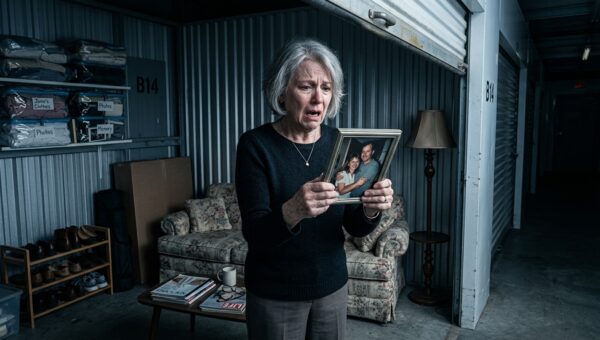
“Just drop them in the blue bin,” the woman behind the counter said, her voice completely flat.
She did not mean to be rude. It was late on a cold Tuesday afternoon, and she was probably ready to go home. I stood there in the drafty donation bay of the West Saginaw Street Goodwill, holding seven of Walter’s coats piled high on my arms. The brown corduroy jacket was right on top.
Walter wore that corduroy jacket every November for as long as we were married. It was his favorite. It smelled of cedar blocks and peppermint candy, and the cuffs were slightly frayed from where he used to rest his wrists on his workshop table.
He died last month, right after the first frost. After forty-eight years of marriage, the house was suddenly too quiet. The mudroom felt crowded with his things. Every time I walked past the wooden pegs by the back door, those coats looked like him standing there, waiting for his boots. It felt like a low, dull ache in my chest every time I looked at them.
I could not take it anymore. I finally packed them into the backseat of our old blue Buick LeSabre and drove down to the donation center. I wanted to get it over with quickly.
The worker, a young girl with a name tag that said Brenda, took the corduroy jacket from the top of the pile.
She shook it out over the metal counter. She ran her fingers inside the pockets, checking for old tissues, loose change, or receipts. It was standard procedure, I suppose.
But then she stopped. Her forehead creased, and she looked up at me.
“Ma’am?” she said, turning the neck of the jacket toward me. “Did you mean to leave this in here?”
I leaned closer. My eyes are not what they used to be, but I recognized the white fabric strip immediately. It was a piece of cotton twill tape, about three inches long, sewn into the lining right beneath the hanging loop. The stitches were shaky, done by hand with thick black thread.
I saw my own name. Margaret. And under it, our home phone number.
But it was what he had written beneath the number that made my stomach do a slow, sick turn. In his uneven, blocky printing, he had stitched: “my wife. please call her.”
I stood there. I forgot to breathe for a few seconds. My hands went numb against the heavy wool of the next coat in my arms.
“Is everything all right?” Brenda asked, her voice softening. She could see my face losing its color.
I did not answer her right away. I reached out and took the gray wool overcoat from the pile. This was his Sunday coat, the heavy one he wore to church on freezing January mornings when the wind came straight off the lake. I flipped the heavy collar back. My fingers were trembling so badly I could barely hold the fabric.